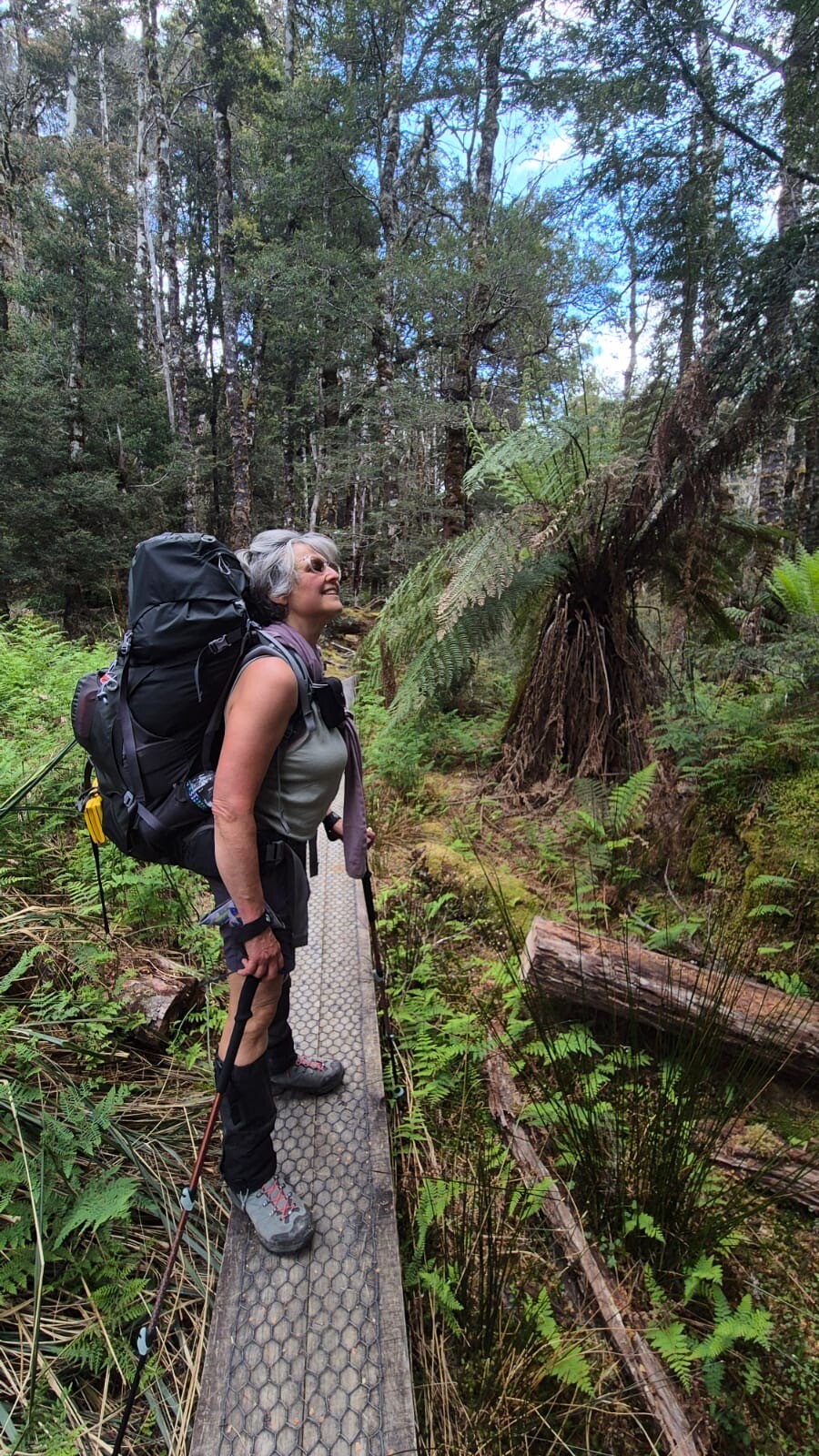
I was born in 1966, a fire/horse by the Chinese calendar, and again in ’26’ we’re in the year of the Fire Horse. As the numbers show this comes around every 60 years, so I’ve made this landmark period in life. These numbers can bring turning points and offer fresh significance, and for me, when I was given an invitation to walk The Overland Track in Tassie this past January, it felt a perfect time to take on a challenge. It had also been one I’ve dreamt – to walk and carry my belongings, in nature over multiple nights.
This would be a slightly bigger challenge than advised for your first multi-day hike, 7.5 days through mountain terrain, and forest, carrying, from the outset, a 19-kilo pack. Notwithstanding, I had no regular fitness regime at all, just a long-term yoga practice and a relatively active lifestyle in the garden and living in the hills, to rally from. The one month I had before the trip, I did static cycling, preparatory hiking with some weight on my back and an over-night hike at Deep creek Conservation Park, and for The Overland Track itself, I was accompanied by experienced hikers (thank goodness). Overall, I was taking a punt as to whether I had the fitness required. Now, after completion, I have been impressed with what my long-term yoga practice has provided me in achieving this hike and I thought I’d share this to advocate for and share a little about the intrinsic nature and power of yoga.
The first day was particularly tough fitness wise, it was mostly ascending. I did slow up the group, and I had the option to go back after day one was complete, but my instincts were, that I was managing, and I knew of strategies for myself to endure and manage more of what was to come. The discipline of mind in yoga practice does offer confidence. Action brings motivation, and we learn that we can access a well of inner resources when in need. We learn practical techniques to increase resilience, endurance, and economise and maintain energy. The ability to assess, access, and use the right amount of energy for the task helps significantly, and this includes proprioception, (awareness of our whereabouts in space), coordination, balance and unity or connection between our focus, our breath and our body.
The terrain varied over the days and the first day was the toughest. After coming to the finish line, at the end of 7.5 days, I was a little pack fit, and my pace had certainly picked up. My ability to get to the finish line, after 100 km’s, was the way I could conserve my energy when needed. I would spend minutes at a time recuperating with a forward fold, resting forwards on my walking poles, head down, taking slow deep breaths through my nose, getting my heart rate to slow and my breath to deepen, mind to relax. I employed what is called an Ujjayi breath on the track, where you make the breath softly audible, taking it through the slightly constricted portion at the back of the throat. This breath promotes focus, increases lung capacity and enhances relaxation. I also used Sitali breath, which is a cooling breath, inhaling through a curled tongue and exhaling through the nose. These breath techniques kept me cool and calm and focussed.
After the first few days of the hike, it was mainly general fatigue experienced, as well as fatigue of the legs and feet, so giving time for the feet and legs to recover at the end of the day, with “Legs-up-the-wall” (or tree), and doing movements for the hips, knees and ankles whilst lying on my back gave complete recovery, range of movement and decreased inflammation or swelling. Lying twists also assisted the spine, shoulders and back to ease from their work.
When managing some hip and back fatigue towards the last few days, doing some poses whilst on the track, like Virabhadrasana III (or names Flying Warrior – balancing on one leg, whilst extending the body parallel to the ground), would get my hips back together, increasing firmness and stability in the hips and lower back. Deep squatting and standing forward folds opened and relieved my lower back and increased length and space in the spine, recovering my back and shoulder muscles from the pack. Yoga, after all, can be taken anywhere and with little or no equipment to achieve excellent results.
Yoga is self-study (Svadhyaya). Whilst in yoga, distractions are minimised, we learn to pay attention to how we ‘do’ our life. The sense of awareness in our yoga practice enables us to see a little below the surface, to what is driving us. We discover that there are deeper layers, beyond likes and dislikes, our ego self, discovering more about who we are, our truth, our wisdom mind, and our discernment, to ‘what is’. Maybe this is why yoga can be confronting at times. In our practice we become still and observant, we increasingly trust the process, showing up for ourselves in a special way. We get to see the ways we think and approach our life, highlighting that we are not perfect. Yoga is a humbling process.
We hold patterns of movement, posture, emotions and attitudes, as we move beyond these boundaries we can see realistically what’s possible. In this process of action, reflection, reaction times slow whilst we can sculpt how we respond, discernment takes place and clarity arises. We can see beyond judgment, bring appreciation and kindness to ourselves, and more of that to each other and the world. Yoga in fact sculpts who we are and how we choose to live. I don’t think I would have taken my hiking journey on so willingly, positively without my yoga mindset.
by Loretta Voivodich